


Mother and daughter, in the shade of a fig tree: the art of vintage costume jewelry
She took over the Françoise Montague workshop in 1978, at the age of 21. Ever since, she has been hunting for treasures. One summer afternoon, between mother and daughter, I asked her how she chooses a vintage piece. I thought I knew her by heart. Some of her answers surprised me.
What is the last vintage piece you bought?
A pair of earrings from a jewelry house that was located under the arcades of the Palais-Royal. They worked with Goossens, Gripoix, and other very fine costume-jewelry makers. Their style was fairly close to Isabelle Canovas.
Why that one?
Because I look for makers and/or distributors who worked with beautiful materials. And because I love the 1980s and 1990s. To me, they were the golden age of vintage jewelry. It’s a little worn, the gilding has shifted, but it can be repaired. That didn’t stop me.
What did you notice first when you picked it up?
Nothing. I felt it first. The weight in my hand, its signature, and the design I had spotted in a photograph before buying it.
When someone brings you a whole lot at once, what order do you look at things in?
That happens often at the boutique. People come to show me the vintage jewelry of their mother, mother-in-law, or grandmother. Two things immediately catch my eye. The materials first: plastic beads don’t interest me; I like glass paste, metal, and originality. I was born into jewelry, so I have an eye for very different kinds of craftsmanship—French, American, English, and German.
Out of ten pieces, how many do you keep?
Sometimes none, sometimes all of them, and sometimes just one. It depends on what they are; the jewelry has to inspire me.
What makes you put a piece down immediately?
When it doesn’t move me. For me to take it, there has to be love at first sight, or I have to know I can resell it, or it has to be missing from my collection. The eighteenth and nineteenth centuries, for example, I know nothing about. I leave them alone.
What do you look at first on a pair of earrings?
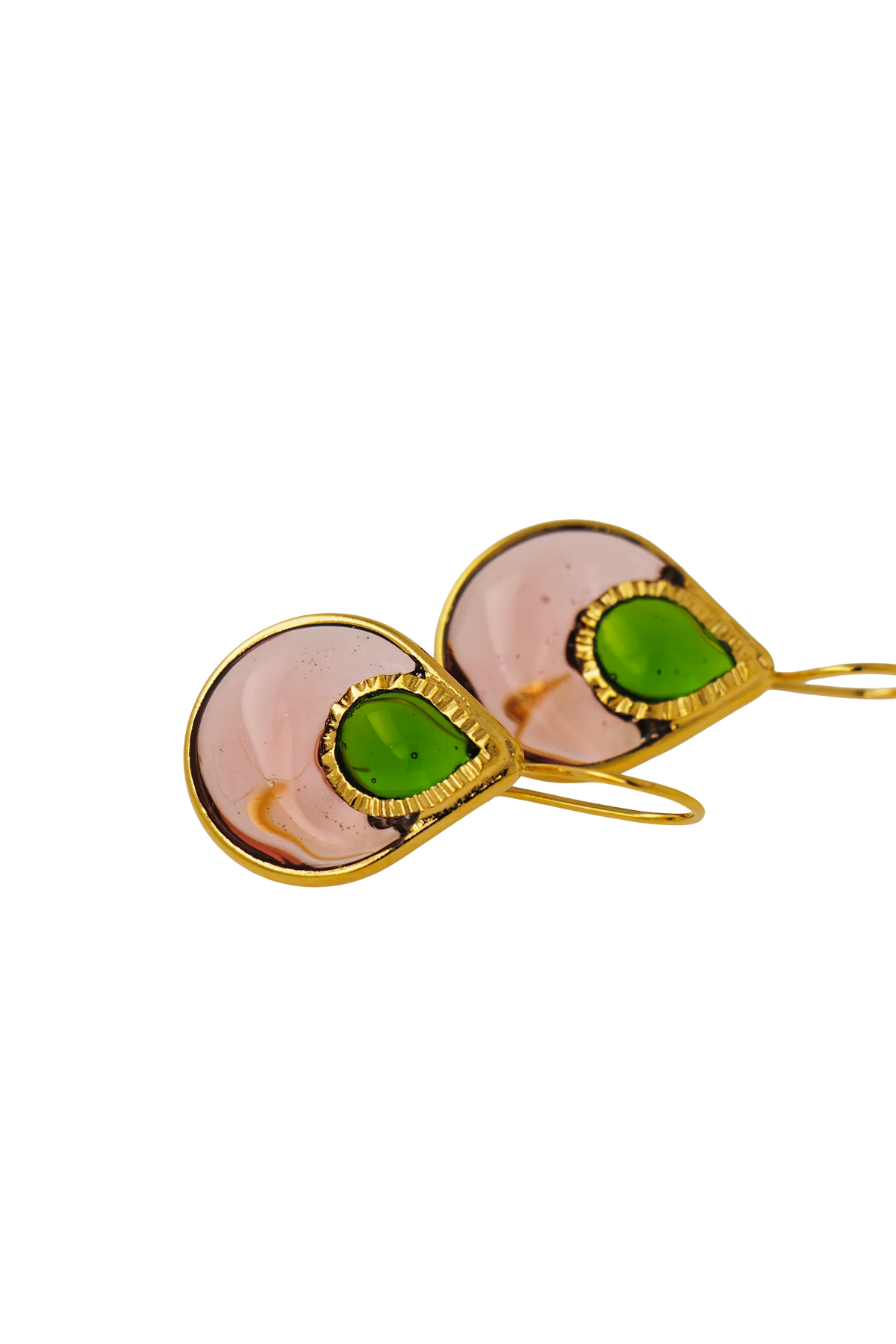
The finishing. The loops, the way the beads are mounted, the clasps, the fittings. And the quality of the raw material. A French stamped piece isn’t the same as an Italian stamped piece or an Asian stamped piece. Nor is a European chain. You can see it.
Where did you learn to have that eye?
As a child. My parents were jewelry wholesalers, and we helped them put the references on the individual bags, ring by ring. I handled the American, English, and German jewelry my father imported. I retain a visual memory of it. I believe all those suppliers have disappeared; I don’t think any of them remain today.
Is there a piece you still remember years later?
The first vintage Françoise Montague necklace I bought back. It was at the flea market, at the Marché Dauphine, on a stand that sold almost no costume jewelry. When I started out, one of the first things Françoise Montague had me do was create a supplier-reference notebook. We had to draw the pieces, assess them, and weigh them in our hands. I opened all the workshop’s little drawers to find her references. I remember very clearly the materials the workers held in their hands. I knew this necklace came from us by the raw materials and the clasps.
Where do you look for the signature? And what if there isn’t one?
Françoise Montague never signed her pieces. We started in 1998, when I opened the boutique and met Patricia Benichou, who became our press attaché. She liked our style because it was different. We had to sign the pieces so they could be credited in magazines. Otherwise, I liked staying in the shadows and keeping our signature to ourselves.
Do you ever buy damaged vintage jewelry?
Of course. That’s our strength—we know how to repair things. A broken bead, a cracked glass-paste element, tired gilding, a broken ring—we know how to deal with it. In our design workshop, we know how to repair and restore.
What makes a piece exceptional?
Its design, extravagance, quality, or signature. I had the good fortune to meet Deanna Farneti Cera. Through her research, she was the one who brought the house into the international jewelry dictionary. Until then, we had existed through our appearances in Vogue and through Swarovski, whose clients we had always been. Thanks to her, I met major specialists in French couture jewelry, Patrick and Godelieve Sigal. These people taught me how to hunt for treasures and look at things differently. It was no longer merchandise to buy and resell. It was a collectible piece, with historical significance.
1978. You’re 21, and you take over the workshop. What do you find when you arrive?
An address on Rue du Faubourg Saint-Honoré, opposite the Bristol. Nine people, all older than me. A secretary who was almost retired. I wanted to prove that I was capable.
What did you change first?
Nothing. I observed. For a long time. Then I changed the stand, and I looked at exports, even though Françoise was already selling in the United States, England, Belgium, and Switzerland, in luxury boutiques. Being different from the others on the French market was essential to me.
How would you define the house’s style?
Someone once asked Françoise Montague that question. She replied: the Françoise Montague style is Françoise Montague. I can’t put it any better. We haven’t changed; we’ve evolved, with the materials and with the women who asked us for something different.
What did Françoise teach you that you still use when creating a piece of jewelry?
Quality, finishing. We like to give our best and perhaps work more slowly, but with greater rigor and discipline.
A customer is hesitating over a vintage piece. What do you tell her?
First, I listen. I want to know who she is, what occasion she would wear it for, and what her budget is. Not all vintage jewelry is expensive. But it isn’t a product made by the millions either; it’s a unique piece. So I look for clues: does she collect a particular animal, flower, or shape? That guides me toward a brooch. For earrings, I really like clips from the 1980s and 1990s, and even from the 1950s and 1960s. That slightly old-fashioned quality gives them style. I believe every piece of jewelry has its woman, and every woman has her jewelry. What I don’t want is for it to remain in a drawer.
Any advice for me?
Patience, persistence—because some periods are difficult; in fifty years of my career, I’ve been through a few. I find that the hardest thing, when you love your work and are passionate about it, is succeeding in your professional life, succeeding as a woman, and succeeding as a mother. Very complicated.
One last word?
You can keep everything, you can change everything—it’s yours now. I hope you keep your passion for the product, with all this technology you master and I don’t master at all. And I hope you keep the pleasure of helping make a woman more beautiful. Of giving her a moment of happiness, with a piece of jewelry. A piece of jewelry from our house.